

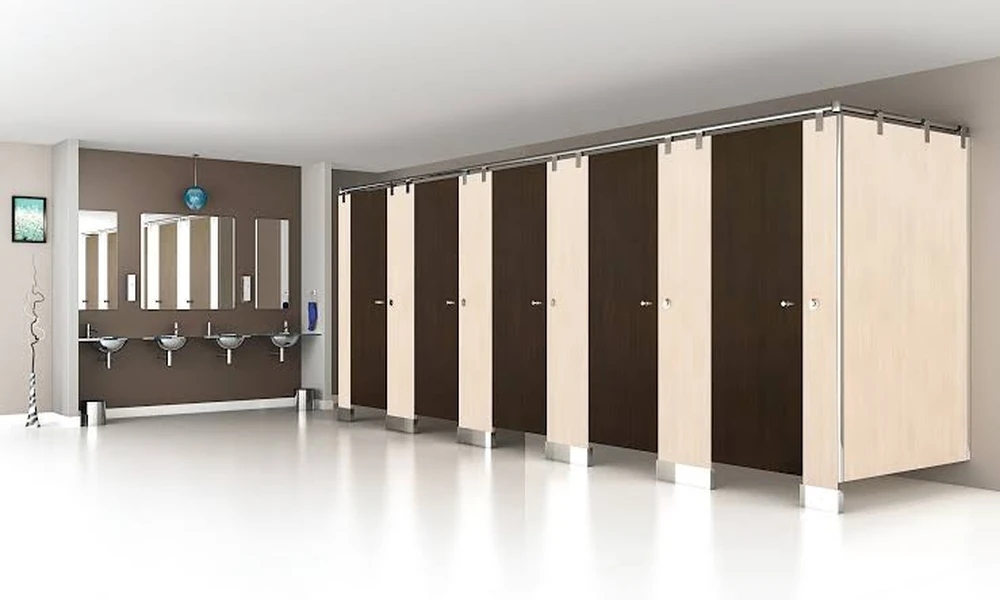
Healthcare washrooms face a cleaning burden unlike any other building type. On any given day, about one in 31 hospital patients has at least one healthcare-associated infection (Centers for Disease Control and Prevention). Every surface in a patient, staff, or visitor restroom becomes part of the infection prevention plan, and toilet partitions are among the largest surfaces in the room.
Why do partitions matter for infection prevention?
Partitions matter because they are touched constantly and cleaned often. Door edges, latches, and panel faces collect contamination from hands and from aerosols released during flushing. Federal guidance recommends cleaning high-touch surfaces more frequently than minimal-touch surfaces in healthcare facilities (Centers for Disease Control and Prevention).
Which partition areas see the most contact?
Four partition areas typically see the most hand contact:
- Door pulls and latch hardware
- Door leading edges and pilaster faces
- Coat hooks and occupancy indicators
- Lower panel areas near the fixture
How broad are partition material options today?
Partition material options now span five major families, and some manufacturers offer every one of them from a single source: solid plastic, plastic laminate, powder coated steel, phenolic, and stainless steel (ASI Global Partitions). That breadth lets healthcare designers match each restroom to its use rather than forcing one material across an entire campus.
How do the families fit different healthcare spaces?
Each material family fits a different set of healthcare priorities. Stainless and phenolic suit areas with heavy cleaning and moisture, solid plastic suits high-humidity spaces such as therapy pools and locker rooms, and powder coated steel and plastic laminate suit offices, clinics, and visitor areas with lighter use.
How does cleaning chemistry influence selection?
Cleaning chemistry influences selection because hospital disinfectants are stronger and used more often than products in commercial buildings. Designers should confirm that partition finishes are compatible with the facility’s disinfectant list and cleaning frequency. Asking environmental services staff for their product list early prevents finish damage that would otherwise appear within months.
What surface qualities help cleaning?
Nonporous faces, sealed edges, and minimal exposed fasteners help cleaning. Fewer seams and crevices mean fewer places for residue to collect and less time spent on detail work during each cleaning cycle.
What guidelines shape healthcare washroom design?
Healthcare washroom design in the United States is shaped by widely adopted guidelines for the design and construction of hospitals and outpatient facilities (Facility Guidelines Institute). Those guidelines influence finishes, cleanability, and room layout, and many states reference them in licensing and construction review.
How does scale affect material decisions?
Scale matters because the country has more than 6,000 hospitals, each with dozens or hundreds of restrooms (American Hospital Association). Systems that standardize materials by restroom type simplify maintenance, parts stocking, and staff training across a campus.
How should staff and patient restrooms differ?
Staff and patient restrooms differ in traffic, cleaning frequency, and abuse risk. Staff restrooms near nursing units see constant use during shift changes, while patient restrooms in inpatient units may see heavy cleaning but lighter traffic. Visitor restrooms in lobbies behave more like commercial restrooms, with surges during visiting hours and outpatient appointment blocks.
How does durability support infection prevention?
Durability supports infection prevention because damaged surfaces are harder to clean. Dents, delamination, and chipped edges create pockets where residue collects, so a material that holds up to impacts and chemicals keeps its cleanable surface for longer and reduces the need for mid-life repairs.
What should healthcare project teams prioritize?
Healthcare teams should match partition materials to cleaning intensity, chemistry, and moisture in each restroom type. Choosing from a broad range of materials, rather than defaulting to one, produces washrooms that support infection prevention goals and stand up to years of rigorous cleaning, while giving environmental services teams surfaces they can clean quickly and confidently on every shift.
